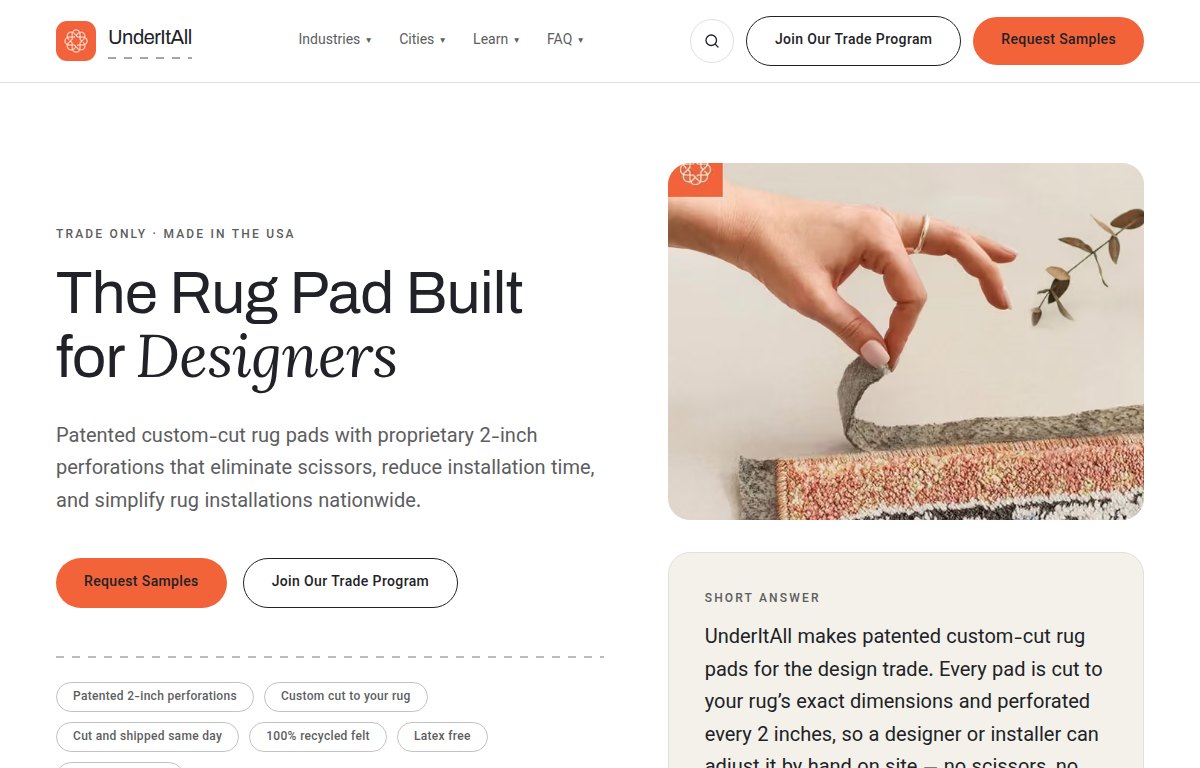
The business
UnderItAll makes patented custom-cut rug pads with two-inch perforations, which let a pad be sized to a rug without scissors. The pads are made in the USA from recycled felt. Designer Rug Pads is the trade-facing side of that business: interior designers, showrooms and specifiers, on trade-only pricing.
Why a separate site at all
A homeowner buying one pad wants a price, a size and a delivery date. A designer specifying pads across thirty projects a year wants trade pricing, consistent spec data, confidence that the product will not delay an install, and an account relationship. Those are not the same page with a different button.
Putting the trade business on its own domain lets the pricing, the language and the whole conversion path live apart from the consumer store, without one undermining the other.
How the site is organised
The build runs to roughly 120 pages on Next.js, in several deliberate families:
- A commercial hub at /custom-rug-pads, which owns the core intent rather than leaving it split across the home page and the how-it-works page.
- A page per product, so thickness and specification queries have somewhere specific to land.
- 46 city pages for interior designers, targeting the trade in the metros where the specifying actually happens.
- Eight industry pages, because a hospitality specifier and a residential designer have different problems.
- A rug pad academy — a categorised content library for the specification questions that come up before anyone is ready to order.
- A trade partner application, which is the actual conversion on this site.
The calculator
The strongest asset on the site is a rug pad time-savings calculator. It takes the product’s central claim — that a perforated pad removes the cutting step on an install — and turns it into a number the visitor generates for themselves from their own project volume. A number somebody calculated is believed in a way that a number you assert is not.
What the schema deliberately leaves out
Product structured data on this site carries no price, availability, rating or review fields. That was a deliberate call: none of those were verified, and populating schema with figures you cannot stand behind is one of the more reliable ways to collect a manual action from Google. Markup should describe what is actually on the page and nothing more.
In the same spirit there is no page for “perforated rug pads” as though it were a third product line. Perforation is a feature of both pads. Inventing a product to catch a keyword is how catalogues become incoherent.
See it live
The finished site is at designerrugpads.com. Everything described above is visible on the live build — go and use it.
More of our work is on the projects page.