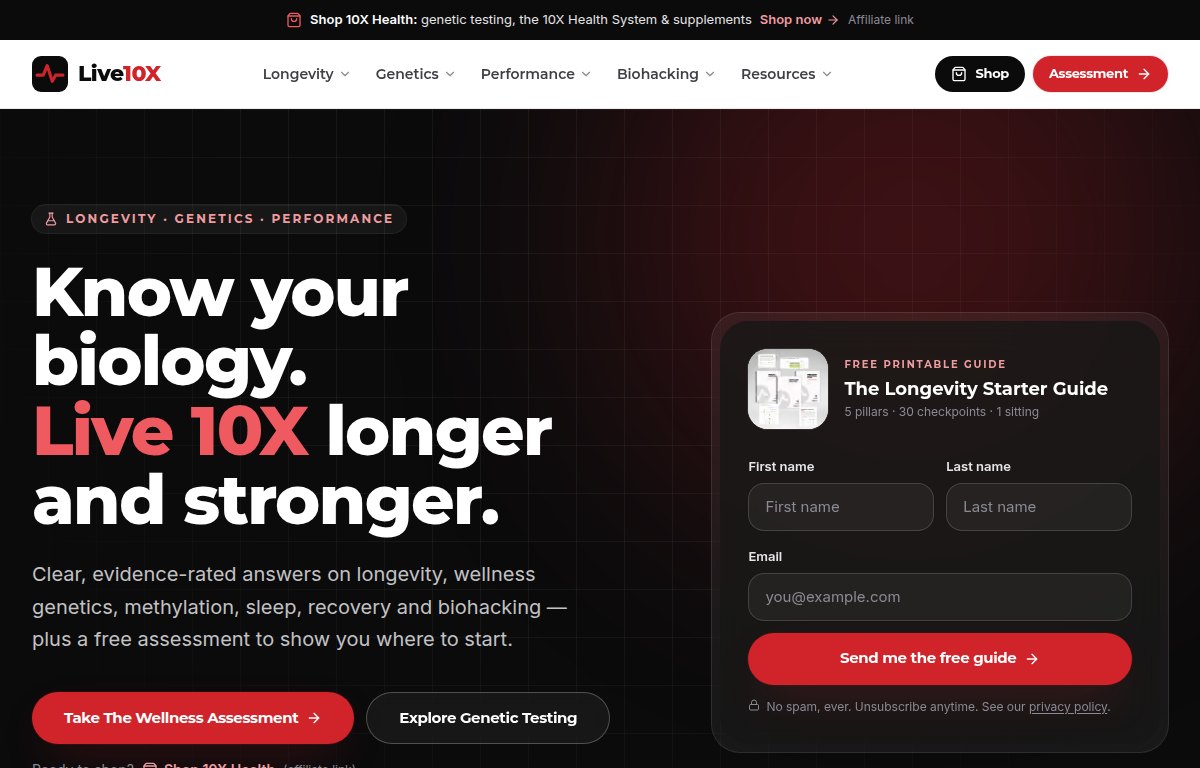
The site
Live10X is an independent education hub covering longevity, wellness genetics, methylation, MTHFR, biohacking and healthy aging. It explains categories of DNA testing — ancestry, wellness, carrier, diagnostic and pharmacogenomic — and how they differ. It earns commission on purchases made through affiliate links, and says so.
Why this is the hard mode of content SEO
Google classifies health content as Your Money or Your Life, which means it is held to a materially higher standard than, say, a recipe blog. Add affiliate monetisation and you have the exact profile that successive helpful content updates have targeted: thin health pages written to place commission links.
The response cannot be to hide the monetisation. It has to be to build the thing that low-effort affiliate sites never bother building.
The trust infrastructure
The site carries a dedicated page for each of these, and they are linked rather than buried:
- Named authors, each with their own page, so content is attributable to a person rather than to a logo.
- A research methodology stating how sources are selected and weighted.
- Editorial standards and a content review policy, covering how pieces are checked and how often they are revisited.
- A medical disclaimer, because the line between education and advice has to be drawn explicitly on a site like this.
- An affiliate disclosure that states the commercial relationship plainly.
None of these are decorative. For YMYL content they are closer to entry requirements, and the absence of any one of them is a reason for a quality rater to mark the whole domain down.
Topic clusters, not a blog pile
Content is organised as topic clusters — a hub page per topic with cluster pages beneath it — rather than as a reverse-chronological blog. A reader arriving on a specific question about methylation can move up to the broader topic or sideways to a related one, and the internal linking tells search engines which page is the authority for which subject.
Alongside the clusters sit a glossary with a page per term, a comparison section, an answers section for question-shaped queries, and a research library. These map directly onto the different shapes a search takes: define it, compare it, answer it, evidence it.
Interactive assets as the conversion
The site’s conversion points are tools rather than newsletter popups: a free wellness assessment, a set of wellness quizzes, and a biological age calculator. These earn the email address by giving something back first, and they attract links in a way that an article rarely does.
Editorial QA built into the repository
The project includes scripts for content planning, generation, validation and auditing, run as part of the normal workflow. On a site that publishes at volume, having a machine check structure, metadata and internal linking before anything goes live is what stops quality drifting as the library grows. It is the part of a content operation that nobody sees and everybody notices the absence of.
See it live
The finished site is at live10x.com. Everything described above is visible on the live build — go and use it.
More of our work is on the projects page.