✦ Case Study
First Coast Dock Repair
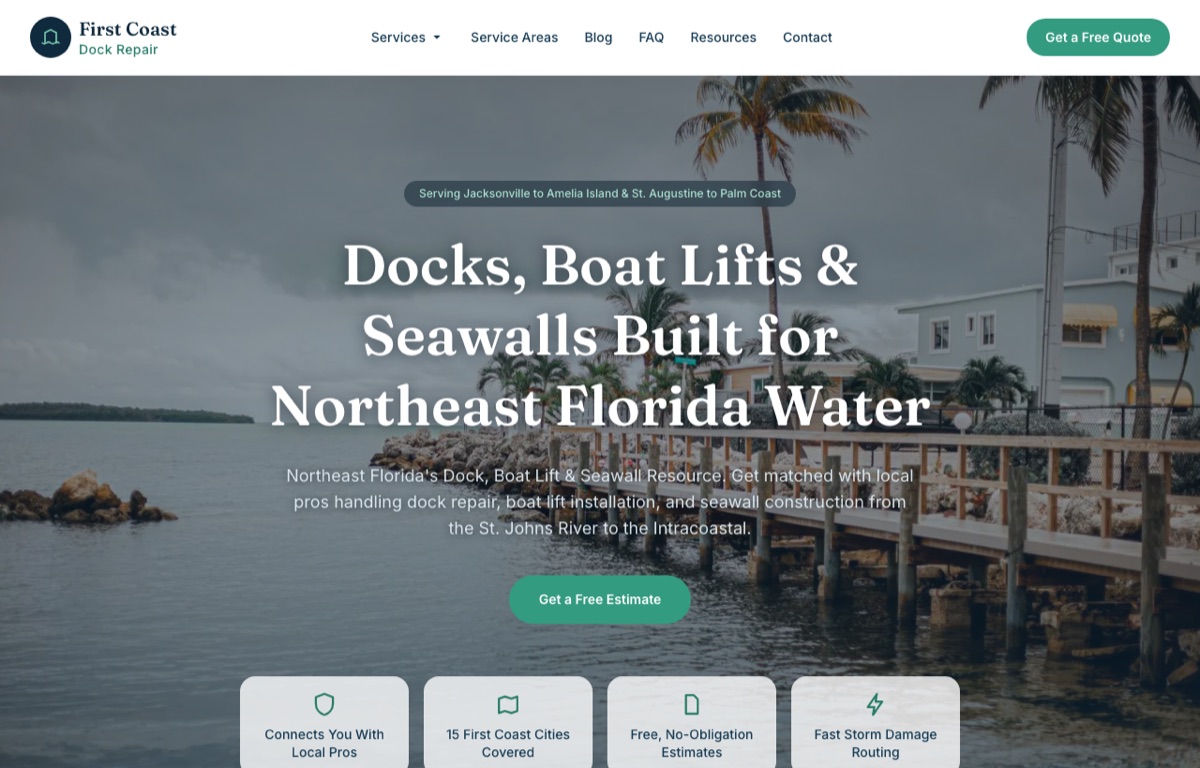
A programmatic lead generation site covering dock, boat lift, and seawall services across Northeast Florida — roughly 170 pages generated from one structured content model.
At a glance
- Industry: Marine construction — docks, boat lifts, seawalls
- Location: Northeast Florida (First Coast)
- Service: Lead generation website, programmatic SEO
- Scale: 15 cities × 21 services, roughly 170 generated pages
- Live at: dockrepairfirstcoast.com
The problem
A typical marine contractor site has a home page, a services page, and a contact page. It competes for a handful of broad, heavily contested keywords and loses to whoever has been building links longest. Meanwhile the searches that actually convert are long, specific, and local — a particular service, in a particular town, with a particular problem attached. There are hundreds of those searches in a market like Northeast Florida, each with modest volume and far less competition.
Nobody hand-writes hundreds of pages. So the problem was not writing content; it was building a system that could produce genuinely differentiated pages at that scale.
The approach
Services, locations, and local research were modelled as structured data rather than pages. Every viable combination — service hubs, city hubs, service-in-city pages, and answer guides — becomes its own page with its own copy, schema, internal links, and sitemap entry, generated from that model.
The part that makes this work rather than spam is the location data. Each city carries real detail: its waterways, neighborhoods, landmarks, and local conditions. A page about dock work on the St. Johns River reads nothing like one about the Intracoastal, because the underlying facts are different. That is the line between a programmatic site and a doorway-page farm.
Technical build
- Structured content model driving all page generation
- Organization, Service, FAQPage, BreadcrumbList, and Article JSON-LD generated per page
- Sitemap and robots.txt built from the same data source, so new pages are crawlable the moment they exist
- Dedicated question-and-answer pages structured for featured snippets, People Also Ask, and AI assistants
- GA4, Google Tag Manager, Microsoft Clarity, and Meta Pixel wired in at build time for per-city and per-service attribution
Editorial and disclosure decisions
Two deliberate constraints shaped the build. There are no fabricated reviews or testimonials anywhere on the site. And the site clearly discloses that it connects homeowners with independent local professionals rather than performing the work itself — which is both the honest description and the one that survives scrutiny.
What transfers
The reusable lesson is that programmatic SEO lives or dies on whether the underlying data is genuinely different per page. Swapping a city name into a template produces thin pages that eventually get filtered. Grounding each page in real local specifics produces pages that deserve to rank. The engineering is the easy half.
We use the same approach on other multi-location service businesses — see lead generation websites and SEO services.
Operating across multiple cities or services?
If your market has hundreds of long-tail local searches, a programmatic build may be the fastest route into them.
Talk About Your Project